MENU
BR | BRL

BR | BRL
-
- Todas as pipetas, dispensadores e equipamentos para manuseio de líquidos automatizados
- Pipetas mecânicas
- Pipetas eletrônicas
- Pipetas multicanal
- Pipetas de deslocamento positivo e dispensadores
- Dispensadores de frascos
- Controladores de pipeta
- Acessórios para dispensadores e pipetas
- Pipetagem Automatizada
- Consumíveis de automação
- Acessórios de automação
- Serviços para pipetas e equipamentos para manuseio de líquidos
Sorry, we couldn't find anything on our website containing your search term.
Sorry, we couldn't find anything on our website containing your search term.
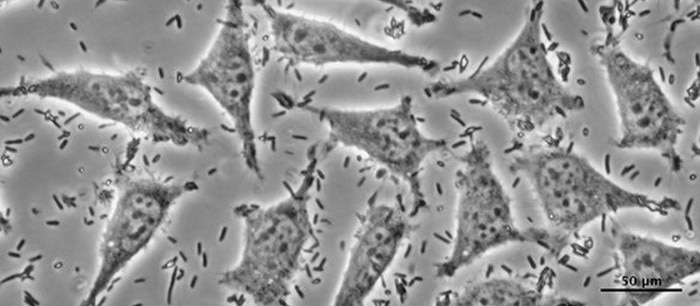
How to recognize bacterial contamination in your cell culture
Lab Academy
- Cell Biology
- Cell Culture
- Contamination
- Cell Culture Consumables
- CO2 Incubators
- Essay
This article was published first in "Inside Cell Culture" , the monthly newsletter for cell culture professionals. Find more interesting articles about CO2 incubators on our page "FAQs and material on CO2 incubators" .
Macroscopic detection
- Increased turbidity of culture medium, medium appears cloudy.
- If medium contains phenol red as pH indicator, a rapid color change to yellow indicates a sudden decrease in pH
Ler mais

Culture media contaminated with bacteria (left) appear turbid and yellow whereas non-contaminated media (right) appear clear and red.
Microscopic detection
Bacteria are much smaller than eukaryotic cells. They appear as dark rod-like structures, spheres or spiral structures under the microscope, and they may exist as single cells, in pairs, chains, or clusters.Bacteria can be visualized using phase contrast and 100x - 400x magnification. Phase contrast facilitates detection, especially at low contamination levels.
Ler mais

Common shapes of bacteria: rod (bacillus), spherical (coccus), and spiral (spirilla).
Moving bacteria in cell culture
Ler mais
Videos not loading, because cookies have been rejected. Change your
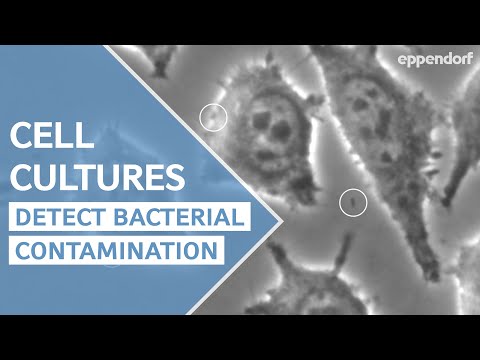
Some bacteria show active movement. You are not sure whether what you see in your culture are cell debris or bacterial contamination? Try to focus on one of the potential contaminants and follow it with your eyes. Cell debris or any precipitates from the medium will only fidget but mostly stay in the same place. Some bacterial strains will actively move away from their current position.
Low levels of non-moving bacteria with round shapes are especially difficult to distinguish from any harmless particles fidgeting between the cells. In this case, only time can bring certainty: without antibiotics the number of particles will increase overnight if a contamination is present. If no increase occurs without antibiotics, most likely harmless debris or precipitates are at fault.
Low levels of non-moving bacteria with round shapes are especially difficult to distinguish from any harmless particles fidgeting between the cells. In this case, only time can bring certainty: without antibiotics the number of particles will increase overnight if a contamination is present. If no increase occurs without antibiotics, most likely harmless debris or precipitates are at fault.
Ler mais

Related documents

White paper
PDF